
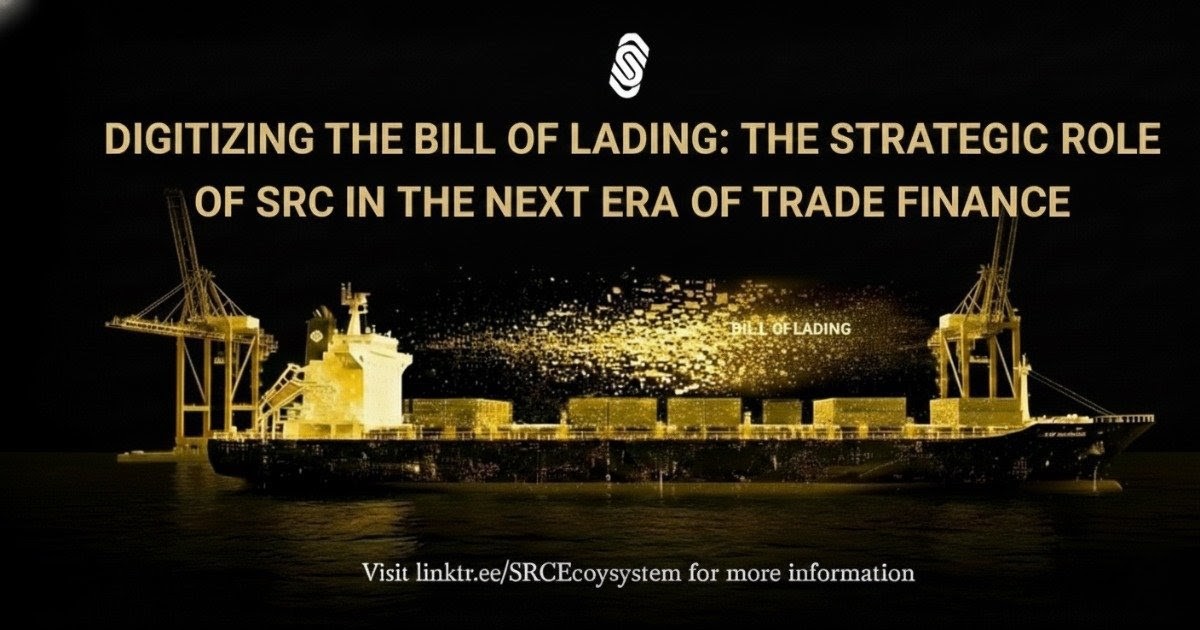
For over a century, the Bill of Lading (BL) has been the backbone of global trade—yet it remains one of the most outdated documents in the supply chain. Paper-based BLs slow down shipments, create compliance risks, increase fraud exposure, and drive billions in inefficiencies every year.
But the global shift is now irreversible: trade finance is moving fully digital, and the BL is at the center of this transformation.
Enter $SRC Ecosystem — a next-generation AI and blockchain-powered trade finance infrastructure designed to modernize how trade is created, verified, financed, and settled.
Why the Bill of Lading Must Evolve
Shipping lines, exporters, importers, and financiers all face the same pain points:
- Lost or delayed BLs create shipment delays and demurrage fees.
- Paper processes slow documentation by days, hurting working capital.
- High fraud risk, especially with duplicated or manipulated BLs.
- Limited visibility between parties across borders.
- Complex manual verification, often involving multiple intermediaries.
As global trade grows more complex and regulatory frameworks demand transparency, sticking to paper BLs is no longer sustainable.
The industry needs faster, safer, and smarter infrastructure.
From Paper to Tokenized Digital Assets (UN MLETR-Compliant)
The $SRC Ecosystem doesn’t just convert documents into PDFs on a blockchain — it elevates the Bill of Lading into a legally recognized, digitally native asset.
1. Tokenized & Legally Valid Under UN MLETR
The Bill of Lading uploaded by the shipping company becomes a digitally native, tokenized, transferable record compliant with the UNCITRAL Model Law on Electronic Transferable Records (MLETR).
This ensures:
- Legal equivalence to paper BLs
- Recognized digital title transfer
- Multi-jurisdiction validity
- Interoperability with global digital trade systems
This allows tokenized BLs on $SRC to function as true documents of title — not just digital copies.
2. Smart Contract Verification of Issuer & Contents
Before tokenization, the BL undergoes smart contract–based verification, checking:
- Authenticity of the issuer (shipping line/carrier)
- Document integrity via hashed signatures
- Structure, fields, and routing details
- Conformity with the underlying contract of carriage
- Validation rules defined by trade partners and carriers
This ensures the digital BL is tamper-proof, trusted, and verifiable without relying on intermediaries.
3. AI-Powered Consistency & Fraud Detection
$SRC Agents automatically validate the BL against:
- Commercial invoice
- Packing list
- Purchase order
- Carrier shipment data
- Historical trade patterns and risk models
AI flags inconsistencies, anomalies, or missing details that manual checks often miss — significantly reducing fraud and operational risk.
4. Real-Time Access for All Stakeholders
Once validated and tokenized, the BL is available instantly to authorized exporters, importers, LPs, insurers, and auditors — with:
- Full traceability
- Immutable change logs
- Role-based permissions
- Zero reliance on email or courier services
This transforms the BL from a static paper document into a living, real-time digital asset.
The Strategic Importance for Trade Finance
The Bill of Lading traditionally serves as:
- A document of title
- A receipt of goods
- Proof of the contract of carriage
Tokenizing the BL on the $SRC Ecosystem enables all these functions digitally, while adding powerful new capabilities:
- Instant collateral verification for trade finance
- Automated stablecoin-based fund flows
- Cross-border settlement via partners rails
- Smart-contract compliance enforcement
- Real-time risk scoring with AI
This creates a fully synchronized environment where shipping data, documentation, and financing align seamlessly.
Why This Matters for the Future of Global Trade
Industry leaders—from ICC to governments—agree:
Digital BLs will become the global standard, with adoption expected to reach 100% across major trade corridors this decade.
The winners in this transformation will be platforms that connect:
- Digital documentation
- Verification & compliance
- Liquidity
- Settlement
- AI risk assessment
All in one unified infrastructure.
This is precisely where the $SRC Ecosystem is positioned.
How $SRC Is Positioned to Lead This Transformation
$SRC is building one of the world’s most comprehensive trade digitization ecosystems, enabled by:
- AI-based onboarding & credit assessment
- Tokenization of trade documents (BLs, invoices, W/Rs, etc.)
- Smart contract pledging and collateralization
- Global liquidity pools from institutional & retail LPs
- Stablecoin cross-border payments & FX
- Settlement rail integrations for on/off ramping
- $SRC Chain for secure, scalable settlements
By combining AI, blockchain, MPC wallets, and UN MLETR-compliant digital records, $SRC provides the foundation for fully digital, trust-based global trade.
A New Era of Trust, Transparency & Efficiency
The Bill of Lading is more than a document — it is the anchor of international commerce.
By transforming it from paper into a tokenized, verifiable, real-time digital asset, $SRC empowers shipping companies, exporters, importers, financiers, and regulators to operate with:
- Faster transactions
- Lower operational risk
- Reduced financing delays
- Higher transparency
- Stronger compliance
- Better liquidity access
- End-to-end digital trade flows
The future of trade finance is digital — and $SRC is building the infrastructure to power it.
For more information, visit srcecosystem.com