
Introduction
For decades, global trade finance has been designed around the needs of large corporates. These models have proven effective for multinational firms with strong balance sheets, centralized treasury functions, and long-standing banking relationships.
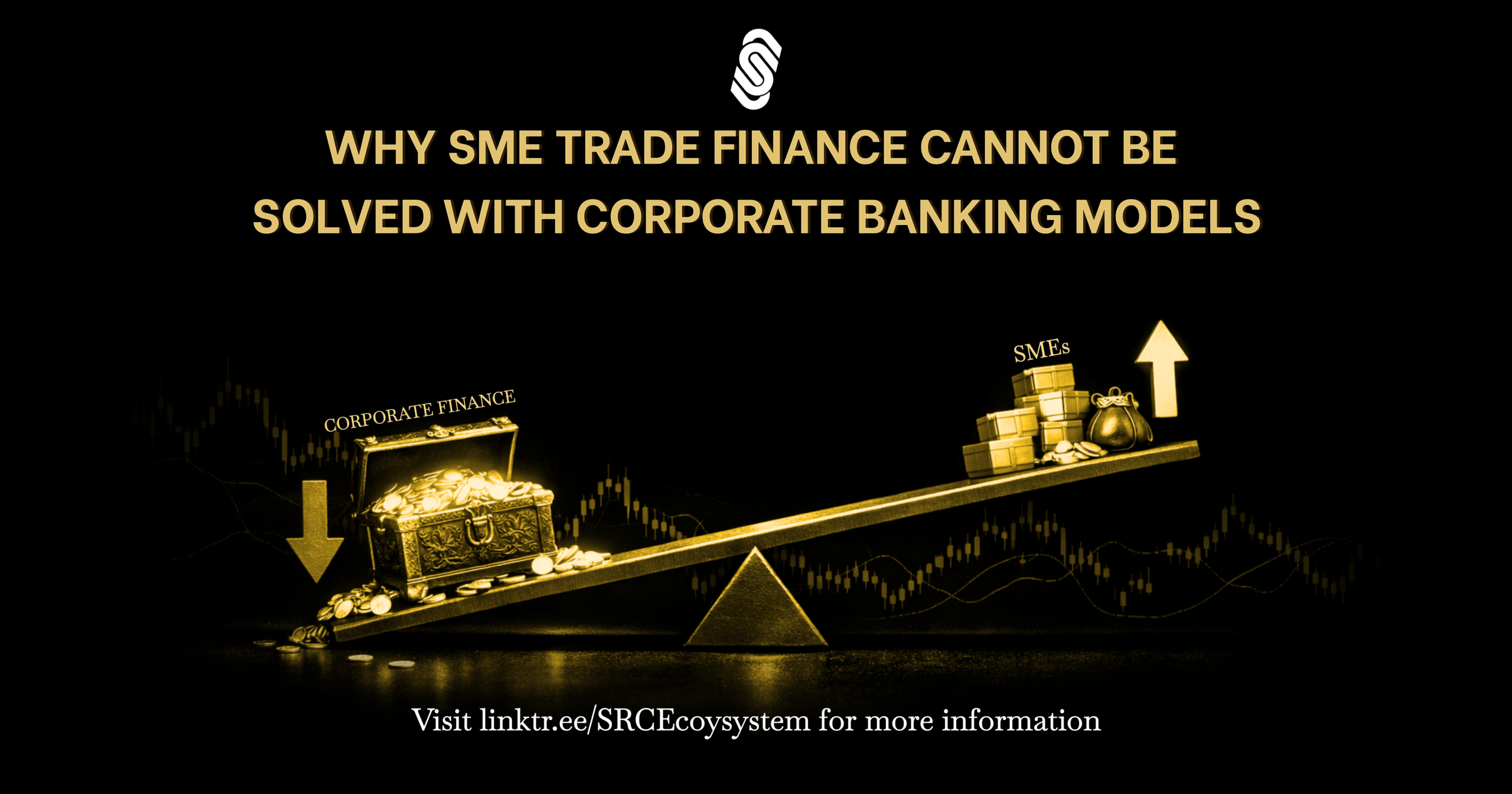
However, applying the same frameworks to small and medium-sized enterprises (SMEs) has created persistent inefficiencies — contributing to the global trade finance gap that continues to disproportionately affect SMEs.
The issue is not a lack of capital.
It is a structural mismatch between corporate trade finance models and SME trade realities.
Corporate Trade Finance: A Balance-Sheet-Centric Model
Corporate trade finance relies on several assumptions that hold true for large enterprises:
Strong audited financials and consolidated balance sheets
Established counterparty relationships
Predictable trade volumes and repeat transactions
Centralized documentation and internal controls
Legal and operational capacity across jurisdictions
In this context, banks primarily assess corporate creditworthiness, with trade instruments acting as risk mitigants rather than primary risk drivers.
This model works — for corporates.
Why These Assumptions Break Down for SMEs
SMEs operate in a fundamentally different environment.
Most SME trades are:
transaction-specific rather than balance-sheet driven
cross-border with limited historical data
executed by multiple independent stakeholders
documented across fragmented and manual processes
Unlike corporates, SMEs cannot rely on consolidated financial strength alone to secure financing. Instead, the trade itself — its execution, documentation, and counterparties — becomes the primary source of risk assessment.
When corporate banking models are applied to SME trade:
credit frameworks overemphasize balance sheets
execution and performance risk is under-modeled
document verification remains manual and siloed
capital becomes conservative by default
This is not a failure of SMEs.
It is a failure of model fit.
The Real Bottleneck: Execution, Not Credit Appetite
Contrary to common perception, institutional capital is not inherently unwilling to finance SME trade.
What capital avoids is opacity.
In SME trade finance, the most significant risks arise from:
counterparty verification gaps
fragmented document issuance (shipping, warehousing, inspection, insurance)
limited visibility into trade execution milestones
weak linkage between contracts, documents, and settlement
When these elements cannot be independently verified at the transaction level, capital allocation becomes constrained — regardless of pricing or demand.
Why Infrastructure Must Precede Financing
Effective SME trade finance innovation must begin before funding is introduced.
This requires infrastructure that enables:
structured onboarding and verification of all trade participants
digital creation of trade agreements between exporters and importers
authenticated issuance of trade documents by trusted stakeholders
execution logic that aligns contracts, documents, and performance milestones
When trade data is standardized, verifiable, and enforceable, financing becomes a natural extension of the process — not an exception.
The Direction of the Market
The future of SME trade finance is not about replicating corporate banking products at smaller ticket sizes.
It is about building transaction-level infrastructure that reflects how SME trade actually operates.
Capital will continue to flow toward environments where:
risk is transparent
execution is measurable
data is reliable
and enforcement is credible
This shift is already underway — driven by the need for efficiency, compliance, and scalability across global trade.
Conclusion
SME trade finance cannot be solved by extending corporate banking models downward.
It requires a fundamentally different approach — one that starts with trade execution, verification, and infrastructure, and allows capital to follow with confidence.
Bridging the trade finance gap is not about increasing liquidity.
It is about making SME trade financeable by design.
For more information visit srcecosystem.com